
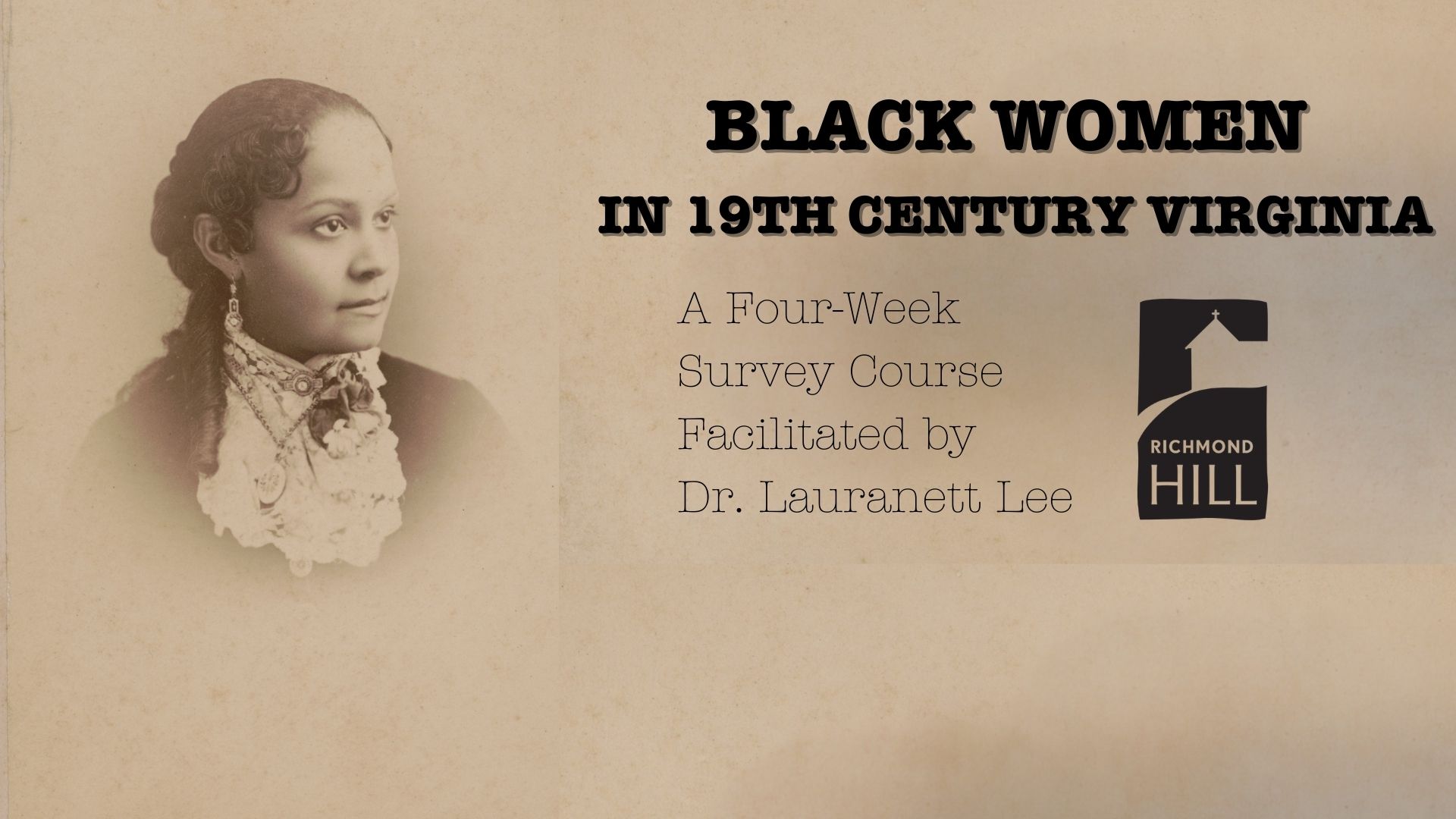
Black Women in 19th Century Virginia: A Four-Week Survey Course
Thursdays in March, 6:30–8:00 p.m.
Led by Dr. Lauranett Lee at Richmond Hill
The Judy Project is named for Judy, a woman enslaved on the Richmond Hill property from 1860 to 1865. Her story is preserved through a recollection written by a descendant of the Wilkins family, who had purchased her decades earlier. On April 3, 1865, Judy witnessed the arrival of the United States Colored Troops in Richmond and is quoted as saying, “Remember, you have seen history here today.”
The words and lives of Black women have rarely been centered in traditional interpretations of Virginia’s history. Yet the stories that survive—often found in fragments and unexpected places—illuminate their humanity, resilience, and unrelenting pursuit of freedom and recognition. Centering Black women’s lives expands our historical narrative and deepens our understanding of the past.
This four-week short survey course introduces participants to the lived experiences of Black women in nineteenth-century Virginia, both free and enslaved. Through documentary history, participants will explore how Black women appear in petitions, legal records, personal writings, and public speeches, and how these sources help us see a history that is too often overlooked.
- Thursday, March 5: Legislative Petitions and Freedom Certificates
- Thursday, March 12: Wills, Inventories, and Letters
- Thursday, March 19: Autobiography, Memoir, and Historical Fiction
- Thursday, March 26: Speeches and Public Voices
Each session will include a lecture, guided discussion, and close examination of historical documents or texts. No prior background in history is required.
This course is open to the public. Advance registration is required, as space is limited. The course is designed for adult learners, faith leaders, educators, students, and community members interested in history, racial healing, and spiritual formation. No prior coursework is necessary.
For questions about the course, please contact Dr. Lauranett Lee (llee@richmondhillva.org, 804-783-7903). More details about each session and the course objectives can be found below.
The suggested donation for each session is $25 or register for the entire course for $75. A reduced rate per session is also available. All money collected will go to support the rehabilitation project of the Dwelling of Enslaved Africans at Richmond Hill. Click the button below to register; contact Rev. Sheryl Johnson (sjohnson@richmondhillva.org) with registration questions or if you prefer to pay offline.
By the end of the course, participants will be able to:
- Identify key types of historical documents that reveal the lives of Black women in nineteenth-century Virginia
- Understand the legal, social, and economic realities faced by free and enslaved Black women
- Interpret primary sources with attention to power, voice, and historical context
- Appreciate Black women’s roles as historical actors, community builders, and advocates for freedom and dignity
Through historical study and shared reflection, participants will:
- Reflect on how spiritual resilience, moral imagination, and sacred worth shaped Black women’s responses to bondage, freedom, and community life, and consider how faith communities today are called to remember and honor these lives.
- Engage historical truth-telling as a practice of racial healing, recognizing how centering Black women’s voices challenges silences in the past and opens space for empathy, repair, and reconciliation in the present.
- Develop skills for reading historical documents as public history sources and consider how archives, storytelling, and place-based history can be used to educate communities and foster justice-oriented dialogue.
Thursday, March 5: Legislative Petitions and Freedom Certificates
- Legislative petitions as written requests advocating for legal or policy change
- The role of petitions to the Virginia General Assembly (1776–1865)
- Freedom Certificates as proof of legal freedom for Black people
- The daily risks faced by free Black women navigating a slave society
Thursday, March 12: Wills, Inventories, and Letters
- Wills and the distribution of property, including enslaved people
- Inventories as records of estates listing enslaved individuals, often by name and family relationship
- Letters written by and about enslaved and free Black women
- Insights into family separation, labor, survival, and uncertainty
Thursday, March 19: Autobiography, Memoir, and Historical Fiction
- Elizabeth Keckley, Thirty Years a Slave, and Four Years in the White House
- Keckley’s life as a skilled seamstress, author, and advocate for newly freed people and orphans
- The Yellow Wife: A Novel by Sadeqa Johnson
- Historical fiction as a tool for understanding lived experience, survival, resistance, and moral choice
Thursday, March 26: Speeches and Public Voices
- Black women’s public leadership at the turn of the twentieth century
- The National Association of Colored Women’s motto: “Lifting as We Climb”
- Economic empowerment and racial uplift in speeches by Nannie Helen Burroughs and Maggie Lena Walker